

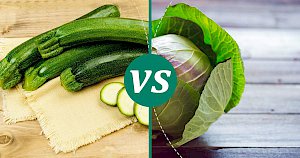
Cabbage vs Zucchini: Which Has More Calories?
Per 100 g, Cabbage has 25 kcal and Zucchini has 17 kcal, so Zucchini has 32% fewer calories.
Cabbage has more fiber (2.5 g vs 1 g). Cabbage has more carbohydrates (5.8 g vs 3.11 g). Relative to calories, Zucchini is the better protein source (7.12 g vs 5.2 g of protein per 100 kcal).
Nutrition Facts
Serving size:
change
5g 10g 15g 20g 30g 40g 50g 60g 80g 100g 120g 140g 160g 180g 200g 220g 250g 300g 350g 400g 450g 500g 600g 700g 800g 900g 1000g
1oz 2oz 3oz 4oz 5oz 6oz 7oz 8oz 10oz 12oz 15oz 20oz 25oz 30oz 35oz 40oz 50oz
Amount Per Serving:
Serving size:
change
5g 10g 15g 20g 30g 40g 50g 60g 80g 100g 120g 140g 160g 180g 200g 220g 250g 300g 350g 400g 450g 500g 600g 700g 800g 900g 1000g
1oz 2oz 3oz 4oz 5oz 6oz 7oz 8oz 10oz 12oz 15oz 20oz 25oz 30oz 35oz 40oz 50oz
Amount Per Serving:
Cabbage vs Zucchini 100g Compare
| per 100g | Cabbage | Zucchini |
|---|---|---|
| Calories | 25 | 17 |
| Carbohydrates | 5.8 g | 3.11 g |
| Fat | 0.1 g | 0.32 g |
| Dietary fiber | 2.5 g | 1 g |
| Protein | 1.3 g | 1.21 g |
| Calcium | 40 mg | 16 mg |
| Iron | 0.47 mg | 0.37 mg |
| Magnessium | 12 mg | 18 mg |
| Phosphorus | 26 mg | 38 mg |
| Potassium | 170 mg | 261 mg |
| Sodium | 18 mg | 8 mg |
| Zink | 0.18 mg | 0.32 mg |
| Vitaminium A | 98 IU | 200 IU |
| Vitaminium B1 (Thiamine) | 0.061 mg | 0.045 mg |
| Vitaminium B2 (riboflavin) | 0.04 mg | 0.094 mg |
| Vitaminium B3 (Niacin) | 0.234 mg | 0.451 mg |
| Vitaminium B5 | 0.212 mg | 0.204 mg |
| Vitaminium B6 | 0.124 mg | 0.163 mg |
| Vitaminium B9 (Folic acid) | 53 µg | 24 µg |
| Vitaminium C | 36.6 mg | 17.9 mg |
| Vitaminium K | 76 µg | 4.3 µg |
| Beta karoten | 42 µg | 120 µg |
More Calories in Cabbage
At first glance, you can see that in cabbage is more calories than in zucchini.
Cabbage has 25 kcal per 100g and zucchini 17 kcal per 100g so it is pretty easy to calculate that the difference is about 47%.
In cabbage and in zucchini most calories came from carbs.
See tables below to compare cabbage with zucchini in details.

Cabbage 100g
25kcalCalories source
- 79% CARBS.
- 18% PROTEIN
- 3% FAT
Zucchini 100g
17kcalCalories source
- 62% CARBS
- 24% PROTEIN
- 14% FAT
Compares of cabbage
Compares of zucchini
Related foods:
Related compares:
About the data
Nutrition values on this page are given per 100 g of the food and are based on the official United States Department of Agriculture FoodData Central database. The exact record used for each food is linked under the tables.
Marcin Piotrowicz – calories-info.com creator · Healthy diet and healthy lifestyle promoter. The information is for general purposes and is not medical or dietary advice.