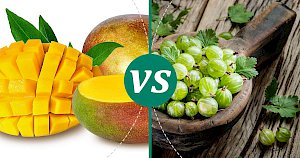
Gooseberry vs Mango: Nutrition & Calories Compare


Gooseberry - calories, kcal, weight, nutrition

Gooseberry vs Mango
Nutrition Facts

Gooseberry
Serving size:
  change
handful (50g)cup (150g)half cup (75g)
5g10g15g20g30g40g50g60g80g100g120g140g160g180g200g220g250g300g350g400g450g500g600g700g800g900g1000g
1oz2oz3oz4oz5oz6oz7oz8oz10oz12oz15oz20oz25oz30oz35oz40oz50oz

Amount Per Serving:
Calories

% Daily Value

Total Fat g
0%

Cholesterol mg
0%

Sodium mg
0%

Total Carbohydrates g
0%

Dietary Fiber g
0%

Protein g
0%

Vitaminium C mg
0%

Calcium mg
0%

Iron mg
0%

Potassium mg
0%

Glycemic Index: 15

* The % Daily Value (DV) shows how much a nutrient in one serving of food contributes to your total daily diet. A 2000-calorie daily intake is used as a general guideline for nutrition advice.
Mango
Serving size:
  change
one mango (280g)cup (165g)half cup (82.5g)
5g10g15g20g30g40g50g60g80g100g120g140g160g180g200g220g250g300g350g400g450g500g600g700g800g900g1000g
1oz2oz3oz4oz5oz6oz7oz8oz10oz12oz15oz20oz25oz30oz35oz40oz50oz

Amount Per Serving:
Calories

% Daily Value

Total Fat g
0%

Saturated Fat g
0%

Cholesterol mg
0%

Sodium mg
0%

Total Carbohydrates g
0%

Dietary Fiber g
0%

Sugars g

Protein g
0%

Vitaminium C mg
0%

Calcium mg
0%

Iron mg
0%

Potassium mg
0%

Glycemic Index: 50

* The % Daily Value (DV) shows how much a nutrient in one serving of food contributes to your total daily diet. A 2000-calorie daily intake is used as a general guideline for nutrition advice.

Gooseberry vs Mango 100g Compare


per 100gGooseberryMango
Calories44 78
Carbohydrates10.18 g17.4 g
Fat0.58 g0.68 g
Dietary fiber4.3 g1.29 g
Protein0.88 g0.69 g
Calcium25 mg10.02 mg
Magnessium10 mg10.57 mg
Phosphorus27 mg0.563 mg
Potassium198 mg204.4 mg
Zink0.12 mg0.563 mg
Vitaminium A290 µg1082 µg
Vitaminium B1 (Thiamine)0.04 mg0.028 mg
Vitaminium B2 (riboflavin)0.03 mg0.038 mg
Vitaminium B3 (Niacin)0.3 mg0.669 mg
Vitaminium B50.286 mg0.16 mg
Vitaminium B60.08 mg0.108 mg
Vitaminium B9 (Folic acid)6 mg0.043 mg
Vitaminium C27.7 mg168.1 mg

When it comes to fruits, gooseberries and mangoes might not seem like they have much in common at first glance. However, both hold unique places in the culinary world and are celebrated for their distinctive flavors and health benefits. Gooseberries, with their tart, vibrant taste, are often found in jams, desserts, and savory dishes. On the other hand, mangoes, known as the "king of fruits," offer a sweet, juicy experience and are widely consumed fresh or used in a variety of recipes. But beyond their taste, how do these fruits compare in terms of nutrition?

Unveiling the Nutritional Profile

When considering gooseberry vs mango, it's clear that both fruits offer a range of nutritional benefits, but they do have some differences in their profiles. For instance, gooseberries contain significantly fewer calories than mangoes, with just 44 calories per 100 grams compared to mango's 70 calories. This makes gooseberries a slightly better option for those monitoring their calorie intake.

In terms of macronutrients, gooseberries also have a higher fiber content, boasting 4.3 grams per 100 grams, which is more than double that of mangoes. This high fiber content is beneficial for digestive health and can aid in maintaining a healthy weight. Mangoes, however, are not to be overshadowed, as they provide a higher amount of sugars, making them the sweeter choice between the two.

Minerals and Vitamins: A Closer Look

Both fruits are excellent sources of essential vitamins and minerals. Gooseberries edge out slightly in terms of calcium, iron, magnesium, potassium, and zinc. For example, gooseberries offer 25 mg of calcium per 100 grams compared to mango's 10 mg, making them a better choice for bone health.

Mangoes, however, shine brightly in their vitamin content, especially with their high levels of vitamin A (765 IU per 100 grams) which is essential for good vision and immune function. Both fruits are equal in their vitamin C content, each providing 27.7 mg per 100 grams, which is great for skin health and immune support.

What About Glycemic Index and Fats?

For those concerned with blood sugar levels, gooseberries have a lower glycemic index (GI) of 15 compared to mangoes, which have a GI of 50. This makes gooseberries a better option for individuals managing diabetes or looking to maintain stable blood sugar levels.

When it comes to fats, both fruits have minimal amounts, but gooseberries contain a slightly higher level of fat, with 0.58 grams per 100 grams, compared to mango's 0.27 grams. However, these are healthy fats, which are an essential part of a balanced diet.

Final Thoughts: Which One to Choose?

In the battle of gooseberry vs mango, the choice ultimately comes down to personal preference and nutritional needs. If you're looking for a low-calorie, high-fiber option, gooseberries might be the fruit for you. However, if you prefer a sweeter taste and a vitamin A boost, then mangoes are the way to go.

Regardless of your choice, incorporating a variety of fruits into your diet is key to receiving a wide range of nutrients. Both gooseberries and mangoes offer unique flavors and health benefits that make them worthy additions to any meal plan. So why not enjoy both and reap the diverse nutritional rewards they offer?

Gooseberry 100g

44kcal

Calories source

  • 82% CARBS.
  • 7% PROTEIN
  • 11% FAT

Mango 100g

78kcal

Calories source

  • 89% CARBS
  • 4% PROTEIN
  • 8% FAT
Marcin Piotrowicz
Author of this page
Marcin Piotrowicz

calories-info.com creator
Healthy diet and healthy lifestyle promoter

All information about nutrition on this website was created with help of information from the official United States Department of Agriculture database.

Add comment